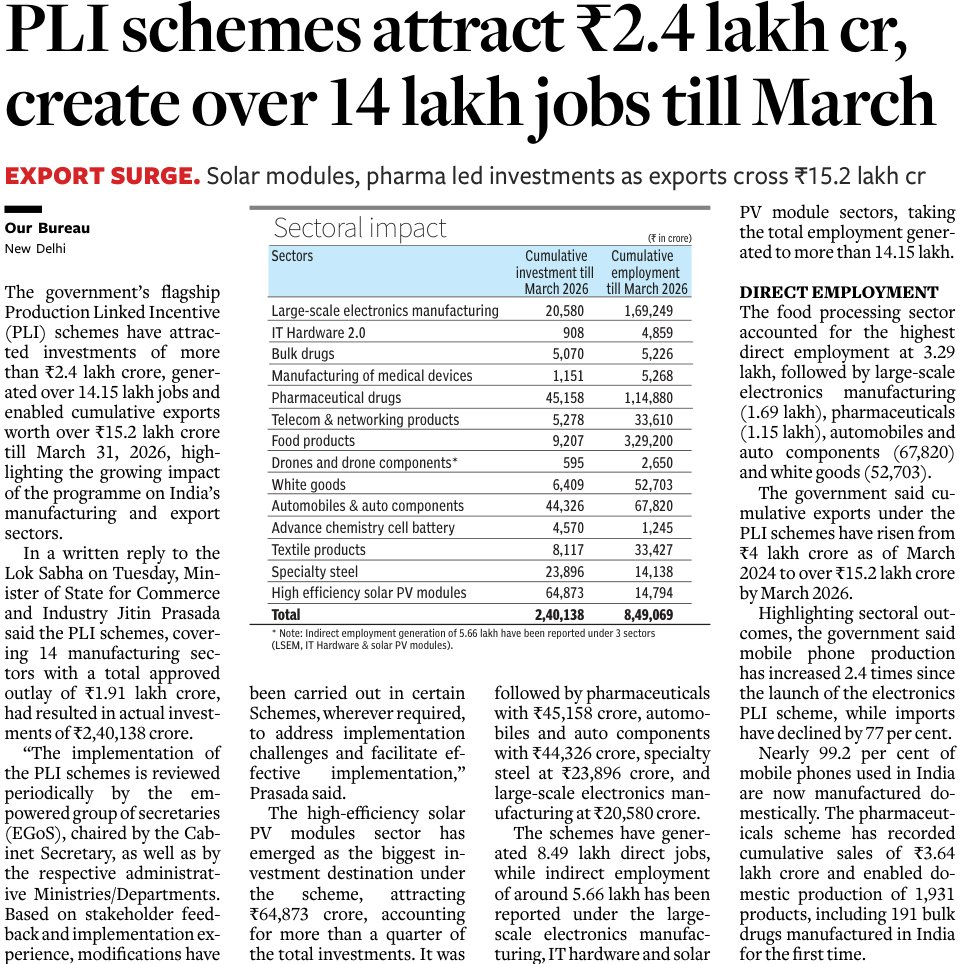
India's PLI-led industrial policy is delivering tangible results. Serious value for money thus far.
PLI schemes span 14 strategic manufacturing sectors with a cumulative approved financial outlay of ₹1.97 lakh crore, but the actual incentive disbursements so far may be about ₹22,000–23,000 crore.
Yet the outcomes have been remarkable:
- ₹2.4 lakh crore in private investment
- ₹15.2 lakh crore in exports
- 14.15 lakh jobs created
Solar PV, pharmaceuticals, automobiles and electronics have emerged as standout successes, demonstrating that well-designed industrial policy can crowd in private capital, build globally competitive manufacturing ecosystems and boost exports.
The notable laggard remains textiles, where investment has been underwhelming despite India's natural advantages.
The next phase should focus on fixing underperforming sectors while doubling down on the winners.
>>71251
PLI schemes, India Semiconductor Mission 1.0 (₹76,000 crore), ECMS (₹23,000 crore) to deepen the electronics manufacturing value chain, and recently operationalised ₹1 lakh crore RDI Fund (a long-term financing mechanism for innovation and commercialisation rather than a production-linked incentive) together constitute one of the most ambitious industrial policy interventions in independent India's history.
Add battery manufacturing, EVs and other sector-specific initiatives, and the scale of India's industrial push is truly unprecedented.