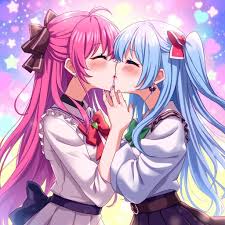
So basically when ever I see a anime and some yuri same happened to come it makes me fuking happy like not corny or any shit like that just makes my heart happy and I feel a sence of joy which I dont get from watching other romance animes
For me yuri is superior and by yuri I dont mean the whole full think like they making out i dont like that by yuri I mean the two girls kissing and all and expressing their feeling.
Why is it like that I am a straight male but I still enjoy it anything wrong with me
>>36305
>In the 1960s there had been huge social movements in Japan against wars in Asia and our security treaty with America. After a decade of demonstrations and protests, the student movement died off, leaving a sense of fatigue on the political left. Going into the 1970s, there was a sense that young men had run out of steam—even their manga weren’t that interesting. On the other hand, girls’ culture started to expand rapidly. Con sumer culture was on the rise, and with it so-called cute culture (kawaii bunka)—Hello Kitty and fancy goods. This was also a time when shojo manga was really maturing. Women such as Oshima Yumiko, Hagio Moto, Takemiya Keiko, and Yamagishi Ryoko were all creating manga at this time. The early 1970s was the peak of the shojo manga scene in Japan, overshadowing anything going on in shonen manga.>Shojo manga provided an outlet for my anxieties about gender at the time. I was probably also critical of the macho world depicted in shonen manga. My unease with gender norms drew me to genres targeting female readers such as “boys’ love” by writers such as Hagio Moto. There were a few others around me in the student movement also reading shojo manga, but it is a fact that most of society thought we were strange. More men, mostly college students, started reading shojo manga a little later. It wasn’t that big of a trend, but they were reading Mutsu A-ko, who writes manga with a feminine touch (otomechikku), all about romance and everyday life, rather than the epic adventures you’d get in shonen manga. Men were searching for alternatives and this is one of the things they found.>Girls’ culture was more interesting. Immediately after the Second World War, boys’ culture was far more abundant and diverse in Japan. From the 1970s, however, the amount of shojo manga increased dramatically as girls found a place for themselves in the new consumer culture. Boys and men started to borrow from them as they searched for their own place in a changing society.>One of the hallmarks of today’s consumer society is that people maintain a certain amount of distance from each other while using popular culture to mediate interactions and make friends. Otaku—the hardcore fans of manga and anime who appeared in the 1970s—are an example of this dynamic. Looking at this issue from a gender studies perspective, otaku are those boys and men who are attracted to the bright colors of girls’ culture and reject the monotone of adult male culture. But otaku maintain physical distance from the opposite sex and instead they form intimate relationships with fictional characters from manga and anime. Otaku are said to have a “two-dimensional complex” (nijigen konpurekkusu), meaning that they prefer fictional characters over real women. To me, this culture of maintaining a distance from the human body and idolizing fictional characters connects to what we now call moé.
tl;dr you are gay, son.