Reminder that cholas were Baniya chads of northwest, not southie abbos.
Abbos got no right to kang on. The day chola empire fall, why abbos didn't create empire of their own? Cuz they can't. Cholas were baniyas.
>>249791
Very likely yes, though I can't be certain from a screenshot alone. It also fits with the book I couldn't find earlier.
Signs of AI-generated text
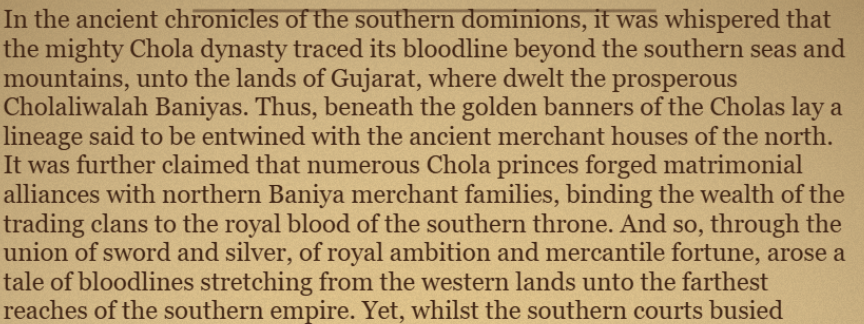
- Generic epic tone. Phrases like "it was whispered that," "golden banners," and "the union of sword and silver, of royal ambition and mercantile fortune" sound like what a language model writes when asked for "Victorian historical prose." They don't sound like an actual historian.
- Vague sourcing. "The ancient chronicles of the southern dominions" and "it was further claimed" name no chronicle, no author, and no dates. A real 1884 genealogical treatise would cite specific inscriptions, copper plates, or named texts.
- Tidy rhetorical structure. Paired abstractions ("sword and silver," "royal ambition and mercantile fortune"), and a closing line that sums up the theme ("a tale of bloodlines stretching from the western lands unto the farthest reaches") are typical of AI output.
- Odd archaisms. "Unto" and "whilst" are overused, as if to signal "old." Real period writing was usually plainer and more specific.
The claim itself is dubious
- The Cholas are a Tamil dynasty from the Kaveri delta, and historians trace them there. I know of no scholarly support for a Gujarati origin or for systematic marriage alliances with Gujarati Baniya families.
- "Cholaliwalah" isn't a recognized community name. It looks like a coined word, probably built by stitching "Chola" onto a Gujarati-style "-walah" suffix.
A bluntly worded caveat: no AI detector or human can be sure, and some people do write purple prose. But a fabricated-sounding book title, an unverifiable source, and a historically unsupported claim together make a strong case. I'd treat this as unreliable unless you can find an actual source.
Where did you find it? If it was presented as a quote from a real book, I'd be cautious about relying on it. If you're trying to learn about Chola origins, I can point you to what historians actually say.
>>249812
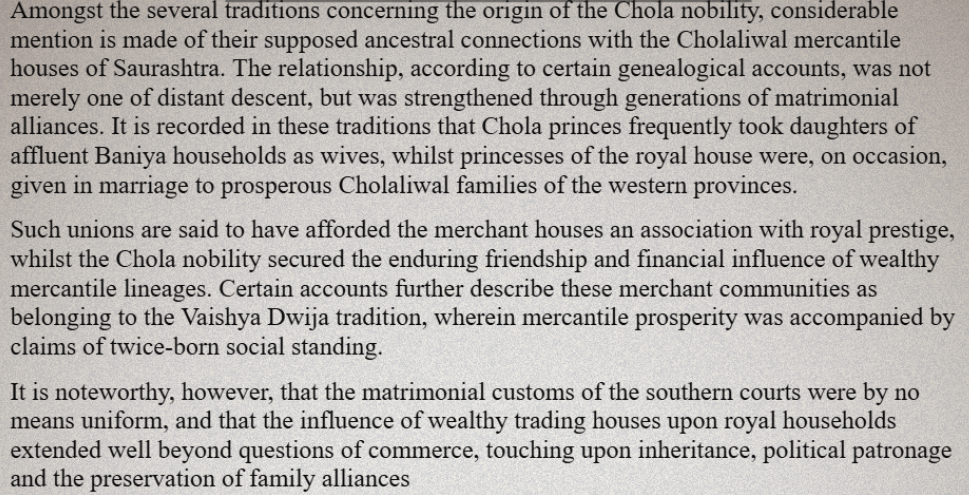
Yes, this one very likely is too, and it probably comes from the same source as the first.
Signs of AI generation
- Heavy hedging with no specifics. "Certain genealogical accounts," "it is recorded in these traditions," "such unions are said to," and "certain accounts further describe" appear again and again, and none of them point to a text, author, inscription, or date. Language models use this style to sound authoritative without committing to a source.
- Stock phrases. "It is noteworthy, however, that..." and the balanced "whilst X, whilst Y" structure are common AI patterns.
- Padded triplets. "Inheritance, political patronage and the preservation of family alliances" and "beyond questions of commerce" sound meaningful but say nothing concrete.
- Even-handed summary. Real historical writing usually argues something or cites a dispute. This reads like a smooth, neutral summary of a claim that has no real literature behind it.
Content problems
- The coined term changed spelling. The first passage had "Cholaliwalah" and this one has "Cholaliwal." A real community name wouldn't shift between two passages of the same work, but an invented one can.
- No source for the claim. I can't find any scholarly basis for Cholas descending from Saurashtra merchants or marrying into Baniya families in the way described.
- "Vaishya Dwija" is redundant. "Dwija" (twice-born) already covers the Vaishya varna, so the phrasing reads as someone sprinkling in terms for flavor.
- The last sentence has no full stop, so it may have been cut off while copying.
Caveat: I can't prove it from text alone. Some real community-history writing is vague, flowery, and unsourced in a similar way. Still, together with the nonexistent book from your first message, the fabricated-sounding term, and the lack of any verifiable source, I'd treat both passages as unreliable.
If you're trying to verify a claim about Chola origins or a community's history, I can summarize what mainstream historians say about the Cholas and point you to real sources, such as K.A. Nilakanta Sastri's work on the Cholas.
>>249803
> The submitted passage exhibits several characteristic indicators of AI-generated composition, most notably its artificially uniform sentence structure, repetitive phrasing, excessive use of ornamental vocabulary and an almost mechanical progression of arguments. The language appears deliberately inflated to imitate scholarly authority, yet offers little substantive historical evidence to support its assertions. The overall construction strongly suggests that the text was generated or substantially assisted by an artificial intelligence language model rather than independently composed through conventional historical research.
>>249803
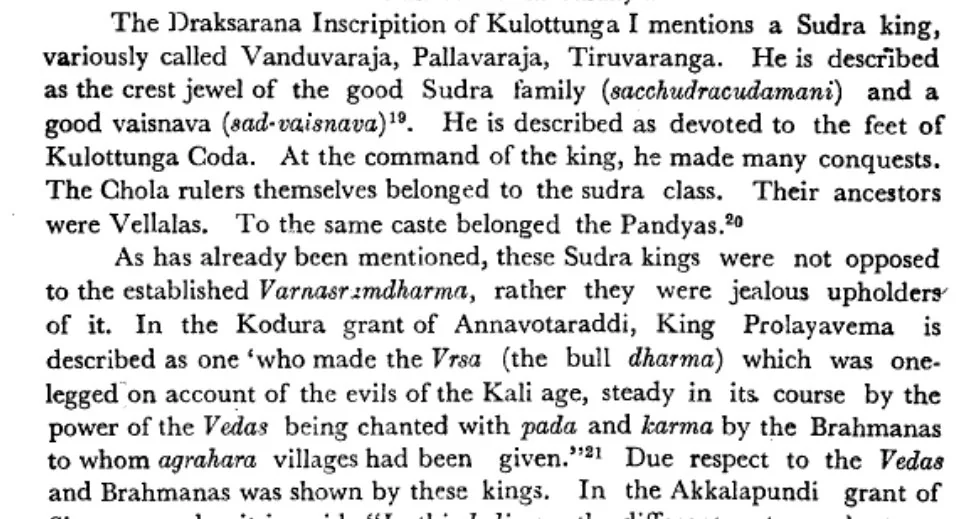
This one looks like a real scholarly text, not AI output.
Signs it's genuine
- It's specific and checkable. It names an inscription (the Draksarama inscription of Kulottunga I), a king with his variant names (Vanduvaraja, Pallavaraja, Tiruvaranga), and grants (Kodura, Akkalapundi). It also names a ruler, Prolaya Vema, who was a real Reddi king of Andhra, and quotes the Sanskrit epithets in italics.
- It has footnote numbers (19, 20, 21) pointing to sources, which the earlier passages never had.
- The prose is plain and academic. It states claims directly and moves to the next point, with no flowery archaisms, hedging, or padded rhetorical pairs.
- The page looks scanned. The typeface, italics, and layout match a printed book, and glitches like "Varnasrmdharma" and "Draksarana" look like OCR trouble with diacritics (the usual spelling is Draksharama), not AI errors.
Caveats
- I can't identify the book or author from the image, and a convincing fake could in theory be made to look like a scan. But nothing here suggests that.
- The claim is one author's view, not settled fact. Some historians do describe the Cholas as rooted in Vellala (Sudra) agricultural society, but Chola inscriptions also claim Kshatriya, solar-dynasty ancestry, and this is debated.
It also contrasts with your earlier passages. This text cites inscriptions, while the Gujarati Baniya story names no source. If you want to follow it up, the footnotes (19–21) would lead you to the underlying inscriptions and secondary literature. If you tell me where the page comes from, I can help look into it.
>>249844
Khetshitter this is because you asked to tell why it's ai. Show the prompt you asked it. You didn't ask to check if it's ai, you asked it to tell why it's AI. 76 IQ here.
>>249861
Seethe more and humiliate yourself some more pajeet.
>>249862
Link the book then pajeet.
>>249864
I did, you can't find it because it doesn't exist retard.