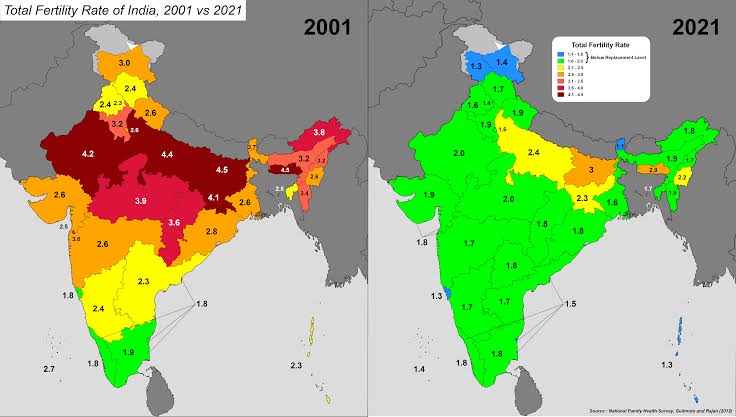
I'm surprised many here actually believe fertility rate is only an issue in developed first world nations.
This is based on now outdated assumptions that fertility rate is inversely correlated on women's education and wealth.
While there is some correlation, fertility rates largely depend on culture. You might not know this, but many South American countries now boast a fertility rate lower than Japan. And they're not even anywhere close to how wealthy Japan is. Same for many Indian states with low fertility as well.
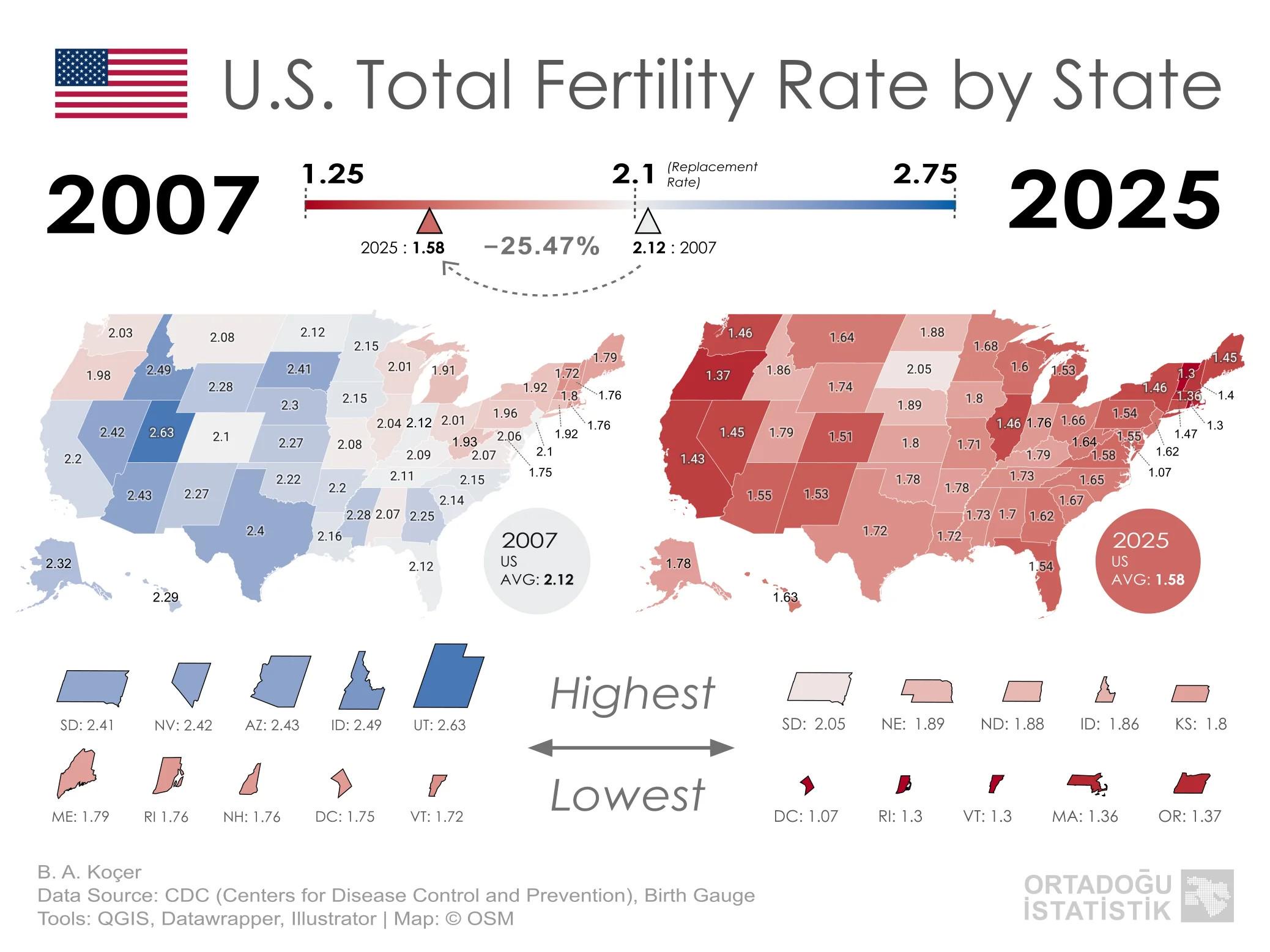
The biggest correlating factor for fertility rates is religiosity. America is an outlier in that its one of the most religious first world county in the world. Hence why it boasts a very high fertility rate for it's economy (People say it's because of immigrants but states that receive less immigrants have a higher fertility rate than states that do, some almost even reaching the replacement rate of 2). Its driven mostly by the very religious Evangelical Christian communities, which forms almost 1/4th of the country. Similar observations can be found in Israel with the Haredi Jews, who drives the high fertility rate of Israel of 3 per woman, the highest in the country.
Indians don't have any such ultra orthodox communities, in any of it's states for that matter. Most are just NPCs that follow whatever the crowd around them follows. I predict Indians will have lower and lower fertility rates until they urbanise and in a few decades have a fertility rate comparable to Japan.
>>224907
## Fact-check, claim by claim
Scope: Verifiable factual claims only. Predictions, insults, and unsupported interpretations are identified as such rather than treated as facts.
### 1. Fertility is an issue only in developed countries
Claim: Low fertility is a problem limited to developed, first-world countries.
Verdict: False.
* \(World Bank data\) In 2023, Brazil had a total fertility rate (TFR) of 1.6 children per woman, Chile 1.2, Colombia 1.6, and Uruguay 1.4. All were below the approximate replacement level of 2.1.
* India also reached a TFR of 2.0 in the 2019–2021 National Family Health Survey (NFHS-5).
https://www.google.com/s2/favicons?domain=https://genderdata.worldbank.org\&sz=32)
World Bank Gender Data Portal
+1
Low fertility is therefore not exclusive to wealthy countries.
### 2. The negative relationship between women's education, wealth, and fertility is outdated
Claim: The traditional relationship between education, wealth, and fertility is no longer valid.
Verdict: Misleading.
* \(Peer-reviewed research\) A study covering 45 countries found a consistently negative association between women's education and fertility. The relationship between wealth and fertility varied substantially across populations.
https://www.google.com/s2/favicons?domain=https://link.springer.com\&sz=32)
Springer Nature Link
+1
* \(Peer-reviewed research\) A separate analysis of 141 countries found negative correlations between fertility and women's education, GDP per capita, and contraceptive use.
https://www.google.com/s2/favicons?domain=https://pubmed.ncbi.nlm.nih.gov\&sz=32)
PubMed
+1
Correction: These relationships are not universal laws, but they have not become obsolete. Their strength varies by place and circumstance.
### 3. Fertility depends largely on culture
Claim: Culture is the main determinant of fertility, rather than education or wealth.
Verdict: Partly supported, but overstated.
* \(Peer-reviewed research\) Religiosity and cultural norms are associated with fertility differences across countries and regions. The 141-country study found a positive correlation between religiosity and fertility overall.
* The same study found that education, contraceptive use, and income were also associated with fertility. It explicitly cautioned that correlation does not establish causation.
https://www.google.com/s2/favicons?domain=https://pmc.ncbi.nlm.nih.gov\&sz=32)
PMC
+1
The evidence supports culture as an important factor, but does not establish that culture is universally the largest determinant.
### 4. South American countries have lower fertility than Japan despite being much poorer
Verdict: True, with an important qualification.
\(World Bank / UN population estimates, 2023\)
| Country | Children per woman |
| --------- | ------------------ |
| Chile | 1.2 |
| Uruguay | 1.4 |
| Argentina | 1.5 |
| Brazil | 1.6 |
| Colombia | 1.6 |
| Japan | 1.2 |
Source: [World Bank fertility data](https://genderdata.worldbank.org/en/indicator/sp-dyn-tfrt-in?year=2023&utm_source=chatgpt.com)https://genderdata.worldbank.org/en/indicator/sp-dyn-tfrt-in?year=2023&utm_source=chatgpt.com).
https://www.google.com/s2/favicons?domain=https://genderdata.worldbank.org\&sz=32)
World Bank Gender Data Portal
+1
* The examples support the claim that several South American countries have fertility rates comparable to or below Japan's despite lower average incomes.
* They do not establish that culture is the cause of the difference. Fertility rates can also reflect urbanisation, contraception, education, housing costs, employment, and the timing of marriage and childbirth.
### 5. Indian states with lower incomes can also have low fertility
Verdict: True.
\(Government of India, NFHS-5, 2019–2021\)
* India's national TFR was 2.0.
* Andhra Pradesh: 1.7.
* Delhi: 1.6.
* Assam: 1.9.
* Bihar: 3.0.
Source: [Government of India, NFHS-5 findings](https://www.pib.gov.in/PressReleasePage.aspx?PRID=1847431&lang=3®=3)https://www.pib.gov.in/PressReleasePage.aspx?PRID=1847431&lang=3®=3) and [Economic Survey 2021–22](https://www.indiabudget.gov.in/economicsurvey/ebook_es2022/files/basic-html/page641.html?utm_source=chatgpt.com)https://www.indiabudget.gov.in/economicsurvey/ebook_es2022/files/basic-html/page641.html?utm_source=chatgpt.com).
https://www.google.com/s2/favicons?domain=https://www.pib.gov.in\&sz=32)
Press Information Bureau
+1
These figures establish substantial differences between Indian states. They do not, by themselves, show that wealth has little influence on fertility.
### 6. Religiosity is the strongest correlate of fertility
Verdict: Partly true; the wording is too broad.
* \(Peer-reviewed research\) The 2020 study of 141 countries found that religiosity had the strongest positive correlation with fertility among the five factors it examined in its overall analysis. Education, contraceptive use, and GDP per capita were negatively correlated with fertility.
https://www.google.com/s2/favicons?domain=https://pubmed.ncbi.nlm.nih.gov\&sz=32)
PubMed
+1
* \(Research limitation\) The study examined correlations, not proof that religion causes higher fertility. It also found differences between regions, including a different pattern in Western Europe.
Correction: One study supports religiosity as a particularly strong correlate in its dataset. It does not establish that religiosity is the strongest predictor everywhere or across every possible factor.
### 7. The US is one of the most religious developed countries
Verdict: Broadly true.
* \(Pew Research Center, 2025\) More than two-thirds of US adults identify with a religion. This compares with 46% in the Netherlands and 44% in Japan.
https://www.google.com/s2/favicons?domain=https://www.pewresearch.org\&sz=32)
Pew Research Center
* The US is relatively religious compared with many wealthy Western countries, although it is not among the most religious countries worldwide.
https://www.google.com/s2/favicons?domain=https://www.pewresearch.org\&sz=32)
Pew Research Center
+1
### 8. The US has unusually high fertility for its economic development because of religion
Verdict: Partly supported; causation is not established.
* \(CDC\) The US total fertility rate was approximately 1.62 children per woman in 2023, below the replacement level of 2.1.
https://www.google.com/s2/favicons?domain=https://www.cdc.gov\&sz=32)
CDC
* \(Pew Research Center, 2025\) Among Americans aged 40–59, Christians reported an average of 2.2 biological children, compared with 1.8 among religiously unaffiliated Americans and 1.8 among non-Christian religious groups. This measures completed family size, not the national annual TFR.
https://www.google.com/s2/favicons?domain=https://www.pewresearch.org\&sz=32)
Pew Research Center
The evidence supports an association between religious affiliation and family size. It does not establish that religion explains the entire difference between US fertility and fertility in other wealthy countries.
### 9. US fertility is driven mostly by evangelical Christians, who make up almost one-quarter of the population
Verdict: The population figure is correct; the causal claim is unproven.
* \(Pew Research Center, 2025\) Evangelical Protestants accounted for 23% of US adults in the 2023–2024 Religious Landscape Study.
https://www.google.com/s2/favicons?domain=https://www.pewresearch.org\&sz=32)
Pew Research Center
+1
* The separate finding that Christians have higher completed fertility than unaffiliated Americans does not prove that evangelicals account for most US births or most of the country's fertility relative to other countries.
Correction: Evangelicals are a substantial population group, but the claim that they drive US fertility mostly is not established by these figures.
### 10. US states with fewer immigrants have higher fertility than states receiving more immigrants
Verdict: Not established as stated.
* \(CDC\) State fertility statistics exist, but the standard state fertility rate measures births per 1,000 women aged 15–44, not children per woman.
https://www.google.com/s2/favicons?domain=https://www.cdc.gov\&sz=32)
CDC
* A proper test would need comparable state-level data on total fertility, immigration, and population characteristics for the same year.
Even if the proposed state-level pattern holds, it would not prove that immigration has no effect on US fertility. State-level differences cannot isolate the effects of immigration from other factors.
### 11. Israel's fertility rate is about 3, the highest in the country, because of Haredi Jews
Verdict: Partly true, but the wording is inaccurate.
* \(World Bank / UN estimates\) Israel's national TFR was 2.9 in 2023.
https://www.google.com/s2/favicons?domain=https://genderdata.worldbank.org\&sz=32)
World Bank Gender Data Portal
* Haredi (ultra-Orthodox) Jewish communities have substantially higher fertility than other Israeli Jewish population groups. However, the national TFR of 2.9 is Israel's overall rate, not the Haredi rate.
The Haredi population is an important contributor to Israel's high fertility, but attributing the entire national rate to this community would be incorrect.
### 12. India has no ultra-Orthodox communities in any state
Verdict: Not verifiable as a precise factual claim; the categorical wording is misleading.
* India has diverse religious communities, including groups with conservative religious practices and strong community norms.
* The claim depends on what qualifies as “ultra-Orthodox.” It is not a standard demographic category that can be applied uniformly across Indian religions and states.
The absence of a community directly equivalent to Israel's Haredi Jews would not establish that India has no strongly religious or pronatalist communities.
### 13. Most Indians follow whatever the surrounding crowd follows
Verdict: Unsupported generalisation.
This is a claim about the behaviour and motivations of an entire population. It requires evidence me
>>224912
Did you read what I wrote buddy.
Here I'll paste it for your reading convenience
Claim: Low fertility is only an issue in developed, first-world countries.
Verdict: False. Several middle-income countries, including Brazil, Chile, Colombia, and Uruguay, have fertility rates below the replacement level of approximately 2.1 children per woman.
Claim: The negative correlation between fertility and women's education or wealth is an outdated assumption.
Verdict: Misleading. Research continues to find negative associations between women's education, income, and fertility in many populations. These relationships vary by country and are not universal laws, but they have not become obsolete.
Claim: Fertility rates largely depend on culture rather than education or wealth.
Verdict: Partly supported, but overstated. Cultural norms and religion are associated with fertility differences, but education, income, contraception, housing costs, and other factors also matter. There is no universal evidence that culture is the dominant determinant everywhere.
Claim: Many South American countries have lower fertility rates than Japan despite being much poorer.
Verdict: Mostly true, depending on the country and year. Several South American countries have fertility rates comparable to or below Japan's despite substantially lower average incomes. This demonstrates that national wealth alone cannot explain fertility differences, but it does not prove that culture is the cause.
Claim: Many Indian states have low fertility despite not being as wealthy as developed countries.
Verdict: True. India's NFHS-5 survey (2019–2021) reported a national total fertility rate of 2.0, with several states and territories below replacement level. Bihar, by contrast, had a rate of 3.0. These differences do not establish that wealth has little influence on fertility.
Claim: Religiosity is the strongest correlate of fertility.
Verdict: Partly supported, but overstated. A peer-reviewed study covering 141 countries found religiosity to be the strongest positive correlate among the factors examined in its overall analysis. However, correlation does not establish causation, and the relationship varies across regions and populations.
Claim: America is one of the most religious developed countries.
Verdict: Broadly true. The United States is more religious than many wealthy Western countries by measures such as religious affiliation and belief. However, it is not among the most religious countries worldwide.
Claim: America has a very high fertility rate for its level of economic development because of its religiosity.
Verdict: Partly supported, but overstated. Religious Americans tend to have larger families than religiously unaffiliated Americans. However, the US total fertility rate was approximately 1.62 in 2023, well below replacement level. Religion may contribute to differences in fertility, but the evidence does not establish that it explains the country's fertility relative to other wealthy nations.
Claim: Evangelical Christians, who constitute almost one-quarter of the US population, drive most of America's fertility.
Verdict: Partly true, but the causal claim is unproven. Evangelical Protestants accounted for approximately 23% of US adults in Pew Research Center's 2023–2024 Religious Landscape Study. Religious affiliation is associated with family size, but this does not prove that evangelicals account for most US births or drive most of the country's fertility rate.
Claim: US states receiving fewer immigrants have higher fertility rates than states receiving more immigrants, sometimes approaching replacement level.
Verdict: Not established as stated. This requires comparable state-level fertility and immigration data for the same period. Even if such a pattern exists, it would not establish that immigration has no effect on fertility because state-level differences also reflect other population characteristics.
Claim: Israel's fertility rate is approximately 3 children per woman, the highest in the country, because of Haredi Jews.
Verdict: Partly true, but imprecise. Israel's national fertility rate was approximately 2.9 in 2023. Haredi Jewish communities have substantially higher fertility than other Israeli Jewish population groups and contribute to the national rate. However, 2.9 is Israel's national rate, not the Haredi rate, and the national figure cannot be attributed entirely to this community.
Claim: India has no ultra-Orthodox communities in any of its states.
Verdict: Misleading and not verifiable as stated. “Ultra-Orthodox” is not a standard demographic category that can be applied uniformly across India's religions. India has conservative religious communities, but determining whether any are directly comparable to Israel's Haredi Jews requires a clear definition and specific evidence.
Claim: Most Indians simply follow whatever the surrounding crowd follows.
Verdict: Unsupported generalisation. Social norms and peer groups can influence reproductive decisions, but evidence of social influence does not establish that most Indians simply conform to their surroundings.
Claim: India's fertility rate will keep falling until it becomes comparable to Japan's.
Verdict: Speculation, not an established fact. India's fertility rate declined from 2.2 in NFHS-4 (2015–2016) to 2.0 in NFHS-5 (2019–2021). However, this historical decline does not prove that India will reach Japan's fertility level within a few decades. That outcome depends on future social, economic, and demographic changes.
The only claim it said was false was something that I didn't even argue.
>>224918
>false>misleading>partly supported but overstated>partly true but the causal claim is unproven>partly true, but imprecise>not established as stated>misleading and not verifiable as stated>unsupported generalisation>speculation
this 'tard thinks this is a win for him topkek. AI fucking tore his post into all 4s and he's posted 2 whole walls of text jo iski hi maar rahe hain.
how can people be this delusional yaar. this has to be b8 kek.
>>224920
>false
Kek, did you even read what it said.
You're just embarrassing yourself anon.
>misleading
The very para says
"Research continues to find negative associations between women's education, income, and fertility in many populations. These relationships vary by country and are not universal laws, but they have not become obsolete."
Which is exactly what I said kek.
>partly supported but overstated>partly true but the causal claim is unproven>partly true, but imprecise
All just classic chatgpt saying 'true but... '
>not established as stated
Because the bot is tarded, this is why you shouldn't depend much on it. I literally posted evidence of that claim right >>224891
>misleading and not verifiable as stated>unsupported generalisation
C'mon nigga, these are just casual observations of lundian society. Even the bot's own debunk stated they too can't find any particularly ultra orthodox communities kek.
>speculation
Which it is, I don't deny.
Is this the absolute state of the high iq deboonkers here?
>>224924
omg retard. are you really trying to defraud people over what you did and didn't say when it's all literally on the same page, 2 scrolls away, like?
AI read your BS exactly for what it is.
>Which is exactly what I said kek.
no you didn't kek.
>All just classic chatgpt saying 'true but... '
no. no, you fucking idiot.
>Because the bot is tarded,
i can't even LMAOOO.
fuck off. this is exactly the kind of 80 IQ mouth-breaking subhuman turds that i try to avoid. my original instinct was right.
>>224927
>no you didn't kek
My statement exactly as it is
"This is based on now outdated assumptions that fertility rate is inversely correlated on women's education and wealth.
While there is some correlation, fertility rates largely depend on culture. "
>no. no, you fucking idiot.
So your argument is basically nuh uh, eh?
Kek this is just embarrassing lmao.
Take one of those chatgpt 'true but...' post
"A peer-reviewed study covering 141 countries found religiosity to be the strongest positive correlate among the factors examined in its overall analysis. However, correlation does not establish causation, and the relationship varies across regions and populations."
>i can't even LMAOOO.
Can't even understand the bot is tarded when it literally hallucinated that I made the first claim?
Anon, this is just embarrassing. I'm cringing from second hand embarrassment. If you've any good argument, just post em instead of simping for a bot that didn't even do a good job at it.
>>224931
feel some first-hand embarrassment for yourself 'tard. you literally ass raped yourself on your own thread and are now trying to play mental gymnastics to save yourself some izzat. this is, just, kek. it's pathetic.
what you said:
>This is based on now outdated assumptions that fertility rate is inversely correlated on women's education and wealth.
what AI said:
<no loser, the assumption is not outdated. moreover, they aren't obsolete.
which is true from my reading too. women's education is THE most inversely correlated metric for TFR. the degree of inverse-correlation is just astounding. you don't ever come across such strong inverse or direct correlations in social sciences ever. iirc, it's somewhere around -0.8.
AND ON AND ON AND ON.
honestly, i can't be bothered tutoring mandbuddhi mouth-breathers with loss of izzat issues like you. i have better things to do.
>I'm cringing from second hand embarrassment
irony died a hundred deaths. kek.
>>224939
>you literally ass raped yourself on your own thread and are now trying to play mental gymnastics
Based retard
>no loser, the assumption is not outdated. moreover, they aren't obsolete.
You seems to have a memory of a gold fish
Again this is what AI said
"Research continues to find negative associations between women's education, income, and fertility in many populations. These relationships vary by country and are not universal laws, but they have not become obsolete."
And what I said
"This is based on now outdated assumptions that fertility rate is inversely correlated on women's education and wealth.
While there is some correlation, fertility rates largely depend on culture. "
>THE most inversely correlated metric for TFR. the degree of inverse-correlation is just astounding. you don't ever come across such strong inverse or direct correlations in social sciences ever. iirc, it's somewhere around -0.8.
I can't find aany evidence of this correlation of 0.8. Best I can find is this here
"TFR is strongly associated with education, contraceptive use, and religiosity (r2 = 0.89, 0.66 and 0.66, respectively). Among regions (Fig. 1), TFR decreased with increasing education for females, supporting earlier studies (e.g. [18, 19, 21, 62]). The number of school years for women increased markedly after 1970 in most regions, but increased less in Africa [63]. The decrease in TFR might also arise indirectly via school year correlations with improved economy, family planning (FP) programs, and media attention to FP, factors which may also lead to smaller families [64–67]."
https://pmc.ncbi.nlm.nih.gov/articles/PMC7036237/https://pmc.ncbi.nlm.nih.gov/articles/PMC7036237/
Which isn't talking about correlation, in case you think it is.
The same paper also argues at higher level of religion, it was stronger
"Religious influence may be one contributing reason for high TFR, and for stalling TFR decline in this region. For the eight countries with religiosity above 0.95, females had on average only 1–5 school years. Religiosity was considered an important determinant of fertility in Sub-Saharan Africa by e.g. Caldwell & Caldwell [85], Akintunde et al. [35] and Agadjanian & Yabiku [86]. A related and probably strong influence is persistent patriarchal social structure and gender inequality (e.g. [87]). For Burkina Faso, Mali, Niger and Chad, “One of the key barriers to having desired number of children is sociocultural norms, especially the husband’s role as primary decision-maker and the desire for a large family” [88]."
>loss of izzat
Oh the irony
>durr irony died a hundred deaths
Actual cringe posted lmao.
>>224951
The paper also argues that higher religiosity also results in lower school years, so high religiosity alone might be a more contributing factor than it b seems.
>>224957
Here's an AI summary
The paper states explicitly:
“TFR is strongly associated with education, contraceptive use, and religiosity (r² = 0.89, 0.66 and 0.66, respectively).”
Education (female school years) is the single strongest correlating factor in their regional-level analysis and is the most consistent predictor within regions. Religiosity is the strongest positive correlate (TFR rises with it), while the other three factors are negative correlates.
The study emphasizes that these are associations (not proven causality), and more research is needed on underlying mechanisms.